Saturday, January 25, 2014

Playing with intensity and volume

My training has been going very well this past month. The running injury I sustained from being overtrained in September is a distant memory. I knew that, when I resumed full training, I would need to do something differently, and the decision to work with Jack Daniels was a good one. I am excited to get my training plan every month, and it always surprises me. I have been able to execute the plan without an issue, and it is not an easy plan by any means!

One thing that is very different with my current plan is the amount of quality running (defined by me as anything faster than marathon pace) I am doing as a percentage of my weekly mileage. When I saw that my mileage was to be kept at 55 miles per week (MPW) through January, I was a bit concerned having always believed that I had to run high mileage to be super fit. I am trying to prepare for a marathon in March, and I have always taken my mileage up to at least 90 MPW before a big race. I also know that Jack won't increase my volume by more than 5-10 miles per week, every three weeks, so projecting forward, I won't be running much more than 70 MPW max for this marathon. Do I need to in order to run a PR in the marathon? I don't think so.

Why? Because of the volume of quality training I am doing. For example, this week, 50 percent of the 60 miles I am running will be run at faster than marathon pace (range of 5:30-6:30 pace; average ~6:15-6:20).  That's 30 miles of running at faster than 6:20 pace! I have never done that much quality volume in training. And, because my total volume is lower, I am handling it just fine. I am not sure that I could handle it if I were running 80+ miles per week. This is significant because I used to get my race-ready confidence from being able to hit goal marathon pace for 9 miles (3 x 3 mile workout) before my marathon. Now, I'm running anywhere from 10-12 continuous miles at a few seconds slower than GMP a couple of times a week and that is an amazing confidence booster. As we all know, so much of marathon performance is based on confidence in our training and ability to hold GMP.

What I notice with this high quality training is that I go into each run feeling relatively fresh. I don't have dead legs to contend with because I'm running 5-8 miles easy, often including 6 strides, on the days between them. The other thing that I really like about this training is it gets me back to having distinct phases of training with a specific training focus for each. I know that I do much better when I progress from speed to strength to race specific training. My last program alternated speed and strength workouts on a weekly basis, and I didn't respond as well to that.

The biggest lesson I've learned about training lately is that one size does not fit all. And, even if the size fit a few years ago, it may no longer fit today. The best plan for each of us is the plan that keeps us running consistently, and we are often the best judge of what that plan looks like. There are a number of different ways to train to become a faster runner. Trying something new is a gift, even if it doesn't pan out. At least you've learned something new about yourself as an athlete. Maybe this big experiment I am undertaking with quality and volume won't pan out, but I don't care. I am hopeful that it will, but I will learn something no matter what.
Photo by Ian Shive (text added).
Maybe the most significant thing that has changed in my life recently is that I quit my day job. Well, sort of. I actually had about 4 jobs I was juggling and now I have 3. The one I quit was paying most of the bills. I had to make a tough call about whether I could put up with some things that I felt were very wrong. I realized I couldn't and decided I would suffer the consequences, if there were any to be had. I had enough independent work built to make the transition financially workable.

Theoretically, this should give me more time to train, right? Theoretically. Like magic, my time shifted to so many other places. I have been somewhat stunned. I had grand visions of enjoying bon bons, wine and napping anytime I wanted. Uh, not even. What this means for those of you who were disappointed that I was not taking any more coaching clients is that I have room to grow now!

One of the wonderful things about making this decision is how much it has freed up my brain to dream about what's next. Maybe I'll continue to work as an independent consultant. Maybe I'll find the perfect fit with a non-profit, University or for-profit company. Maybe I'll start my own non-profit. What I know is that, when I set my mind to whatever it is I decide I want to try next, I have a high level of confidence that I can make it happen. I have running to thank for helping me find that confidence in myself.

Now, get out there and train like it's your job!

Sunday, December 29, 2013

Ending 2013 on a high note

I honestly can't believe that we are at the end of 2013 and that I haven't updated my blog in almost a month! Sorry!

So much has happened these last several weeks, so I will attempt to quickly hit the highlights.

My 5 a.m. running crew.
They are up to running12 milers!
1. I am training Pain free. This is a HUGE deal. I have not had pain from my injury for at least three weeks and am now able to train like normal. I might go so far as to say that I am taking running for granted again. It is so nice. I know many of you can relate to the mental torture that an injury wreaks. This one was insidious. The pain didn't come on until after about 4 miles, so I wasn't really able to do out and back runs longer than 2 miles. I was stuck running loops so I could abandon ship if I felt pain. This also meant I couldn't meet anyone to run since I couldn't really guarantee I would make it all the way. This sucked because I love my running buddies and there's no better way to socialize with running buddies than running together. I am so glad I am able to train with them again. I am also back to running with my 4-legged buddies. We have worked very hard on not pulling.

2. I am getting fit. After spending 12 weeks on the injured reserve list, I was not sure how much fitness I had lost. I didn't completely stop running during that period, but not being able to run longer than 4-6 miles at a time takes a toll. These past four weeks, I have been able to execute my plan as written and it has not been easy! Whereas at the beginning of the month, I couldn't run over 8 miles, this month I've run four, 12+ mile runs! So, exciting. Two of those runs had 10 miles of marathon pace (MP) in the middle. I was nervous about these workouts given how little longer running I had done in the preceding 3 months. I was shocked when I ran the first 10-mile MP workout in 1:04:30. It felt awesome and my heart rate was well within the marathon zone (for me, anyway). Last weekend, I ran 13 miles with 10 miles at MP and was thrilled to run that in 1:03:10 for the 10 miles with the same average heart rate as the workout two weeks before. My interval workouts are becoming speedier as well each week. Clearly, I didn't lose much fitness during the time I was injured. I wonder about this since my mileage was so low, AND I decided not to cross train. This was a big change for me. I typically work my butt off cross training when injured, but I ran across a video of Coach Jack Daniels discussing cross training during injury, and it resonated with me. Of course being able to do some running and being able to do speed work were huge factors keeping me from going crazy. So, not cross training was palatable. Oh, and my Garmin 620 is a dream. Last time I mentioned that it was not quite reporting accurate VO2Max results, but that changed this month. As of today, my VO2Max is now at 59! That's actually pretty darn close to where I think it should be given my workouts and heart rates, though it might be a bit on the high side.  

3. Next Marathon? Right now, I am running ~50 miles per week with a long run of 12-13 miles. I am signed up for the Napa Valley Marathon on March 2nd. The math reveals that I have about eight weeks to go before that race. It's hard for me to picture a world where I can be ready to run sub-2:43 in eight weeks given where I am now. I actually feel really confident about my fitness, especially after running 10 miles at very close to goal marathon pace last week. However, I am not used to having so little weekly mileage and long run mileage under my belt at this point in a training cycle. On one hand, I feel like I should take advantage of the fitness leaps I'm making and just see how far I can get in the next month or so. I will absolutely not push my training to a point that will injure me, but maybe I don't need all the mileage and long runs. Could I run a marathon PR off of a max of 70 mpw and few if any 20 milers? My friend Jen reminded me that I have years of endurance under my belt and maybe I don't really need to work on that aspect of my training for this next race. It is a leap of faith. I have toyed with the idea of pushing my next marathon race to the Modesto Marathon, 3 weeks later, or even Boston in April. With Boston, I am waiting to hear whether I can gain entry into the elite women's field. The cut off is 2:48 for masters runners and I ran 2:48:50 in Eugene. They will give the remaining elite entries to those not meeting the standard, but I have been told they won't reveal this list until late January at the earliest and early March at the latest. Maybe a little too late for planning purposes.

4. Coaching. I recently jumped in the USATF Level 1 Coaches' training because it was being taught locally, and I wanted to be credentialed, officially. It was a serious time commitment, but I decided it was well worth it since I really enjoy coaching. I actually learned a ton from this course even though it was very focused on youth and track and field events. My coaching side business is soaring right now and I am having so much fun with the athletes that I help. I am learning so much from them and am grateful to have the time to be able to work with them. I have pretty much reached my limit in terms of number of athletes I can handle at this point. I might be slightly over, but that just means I sleep a little less.

The Coaches' training also gave me a goal for 2014. There was much talk about the pistol squat being this magical exercise that every athlete should be able to do. When I asked the trainers to demonstrate, not really knowing what it was, they looked at me sheepishly and pointed at someone else to demo the move. Once I saw what it entailed, I realized why they couldn't demonstrate it. It's hard! There are so many aspects of strength and flexibility needed to do this move. So, I decided it would become my strength-training focus for 2014. I am doing progressive training to get there, but it is going to happen! The Genius thinks I'll have it in a few months but my big limiting factor is my ankle flexibility. I will work on that and be pistol squatting to impress the masses soon enough. Here's a video of some knucklehead doing pistol squats, but it's really the most impressive example I could find.

Happy New Year Everyone!                    

Sunday, December 1, 2013

A race and a toy

Jaymee and Cindy #2-3 old girls at the Run to Feed the Hungry.
I am happy to report that I finally ran a good 5k: the best I've run in over 2 years. I ran the Sacramento Run to Feed the Hungry on Thanksgiving Day in 18:13 and placed 4th overall; second master. I love running this race and have done so nearly every year that I have been running. In fact, the throw-away shirt I wore to the starting line was from the 2005 event.

I had a lot to be excited about before the race. My Garmin Forerunner 620, which I ordered through REI in late September, finally arrived earlier in the week. I couldn't wait to test out all of the new data collecting features. It gave me such a warm fuzzy feeling inside while I was racing to know that my little watch was gathering all of this data that I could go home and geek out over later in the evening.

Let's back up a bit to review my last couple of weeks of training. I have been on a very conservative program to allow my leg to get its groove back. While I have been able to run short, fast workouts, I can't get past about 8 miles of running without feeling pain. My body is still using the same old, tired pattern that it's been using the last couple of months that causes my right glute to become very fatigued by around mile 5 and all hell breaks loose down the rest of the leg. If I run fast for 2-3 miles in the middle of that, I can get 8 miles out of the day.

This is obviously frustrating. While we may have pinpointed the hound-induced cause of the problem, so far we haven't fixed it. After laying off strength work and some of the exercises that John Ball had given me to do to allow some muscle activation exercises to work their magic, I am jumping back on the strength train. I noticed a marked regression the second week after stopping the strength exercises even adding in several complete rest days.

As a result of this prolonged injury, I have only been able to average about 30 miles per week for these past 9 weeks. A friend of mine said that she was glad I was being smart about the injury, but it's really not about me being smart. I would love to be able to be a dumb runner and continue to run through the pain. I literally can't run more than I have been. The pain stops me.

Given the state of my training, I was uncertain about what to expect in Thursday's race. I have had some great speed workouts, though they have been limited to 2 miles or less total volume of fast running. I have done a couple of tempo runs over the past month as well. I thought I might be able to hold 6:00 miles on a good day.

The hardest part about this race was getting to the starting line. Aside from the fact that I was nervous about having my leg give out during the race, I also hadn't run a decent 5k in a long, long time. The few short races I ran over the summer and into the fall were disastrous. I also don't like the special pain of racing the 5k. While I think that might be the case for many people, I do know some crazy ones that love the feeling they get from the 5k. This girl would much rather run a marathon.

I actually felt good during the race for the first couple of miles with splits of 5:42 and 5:51. The last mile was a 6:02 and definitely reflected my lack of endurance. Nonetheless, I was very happy with this race. It's clear to me that, once I can resume full training again, I have a great base of speed to work from.

When I got home and downloaded my data, I really did have a great time looking at all of the new information. The Forerunner 620, when coupled with the heart-rate monitor, has the ability to collect data on all kinds of running economy-related variables. It measures ground contact time, stride length, stride rate, and vertical oscillation. It also attempts to estimate your VO2Max. That one needs some work. After running an 18:13 5k, it told me that my VO2Max was 47 and predicted I could run a 22:30 5k. Um, yeah. UPDATE: Something magical happened and my VO2Max just increased to 53! While still on the low side, it's much closer to the 56 that I estimate it to be right now.

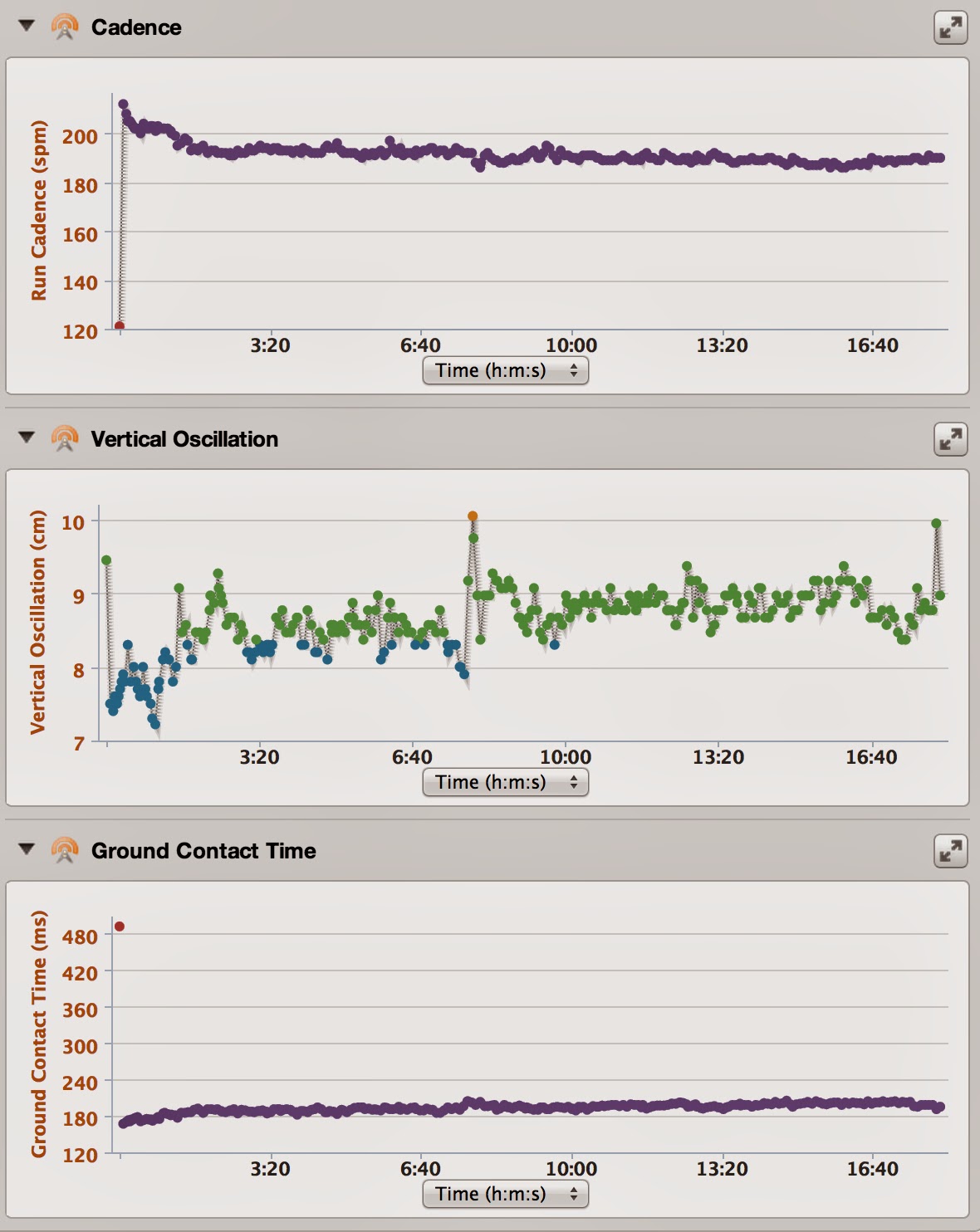
The other measurements may or may not be accurate, but they did change in a predictable way as I became more fatigued at the end of the race. Here are a couple of charts from my 5k race:


It's pretty clear that my efficiency decayed about halfway through the race. I got all bouncy and spent more time on the ground in the second half. I also liked being able to see what my heart rate was doing during the race. I never looked at the value while I was racing, but it was nice to confirm that what I have been calling my max HR is probably pretty darn close. My HR took about 2-3 minutes to reach a peak value of around 180 where it stayed the rest of the race. I have estimated my max HR to be around 185-190. It surprises me a little that I could run for 16 minutes that close to my MaxHR, but I guess that's why the 5k hurts so much. 

Another thing that's fun to do is to compare some of these values with different running efforts. I have done this below with an easy run and my 5k race. Notice the big difference in cadence, vertical oscillation and running stride length between the two. It will be fun to see how/if these values change as I am able to run more mileage and resume doing drills, strength training and strides.


All in all, I like the new Garmin. It's much lighter, fairly easy to use and only has a few glitches that I assume they can fix with firmware updates (can't transfer via wifi on some computers--appears to be a known issue). I am looking forward to testing out the 'find my runner' feature using the iPhone app so the Genius can find me when I'm out on my run. I think this will be a super handy feature to have during a marathon, where you will know exactly where your runner is on course at all times!  

At this stage in the game, I am taking my training day by day. I have a training plan but am never sure whether I'll be able to complete the workouts or not. It is emotionally hard but I try to have few expectations for each run. When I do, and they go poorly, it can ruin the rest of my day. This is why I do most of my runs in the evening these days (followed by some wine). Conversely, when they go well, it can mean a really fun ride until the next run. I am still riding the high of that 5k last Thursday.       
                     

Wednesday, November 13, 2013

Where the heck have I been?

I have been meaning to write an update post for weeks now. I kept putting it off until I had something concrete to write about. I finally realized that everything is always in flux, and you can't predict what will happen tomorrow. So, I will give you what I have now. So many things have changed.

1. I decided a while back not to run CIM.
2. I have a new coach.
3. I am running pain free again.

The CIM Decision

Marathon training was going really well several weeks ago, and I was really excited about CIM. When my IT band started acting up, I knew that I needed to be very careful. I tangled with Gerdy's evil tubercle in 2010 and was out of commission 7 long months. I now know that you can't force it with IT band pain. I also know that rest does not make it better. Treatment of the underlying issue is the only way to get rid of it for good.

Given that, it was pretty easy to make the decision to drop out of marathon training. It sucked slightly that I didn't have a good race to show for all of the training I had done. However, fitness does not disappear overnight. If I am smart and make sure that my body can handle the training load, I may set myself up for a brilliant next marathon training cycle.

My New Coach

Finding myself suddenly injured, I spent a lot of time reflecting on my training. I realized that I made a classic training mistake in that I didn't obey my own 3/1 rule of build/recovery. This rule requires 1 week of recovery for every ~3 weeks of hard training. I was feeling so amazing that I thought maybe I didn't need the down time. Actually, I wasn't really paying much attention until I started having pain in my leg. Then, I looked at my training plan and realized what had gone wrong. I had stressed my tissues beyond their ability to recover. One of my favorite blogs right now is written by Craig Payne and called the Running Research Junkie. I particularly liked his recent post about how to prevent overuse injuries. One passage really sang to me:

"The training routine:
The key to load management is the training routine. That is where a good coach or at least good commonsense comes in. Its all about managing the load on the tissue to such a point that the load encourages adaptation and the load is not so high that the tissues get injured. Way back there was the good old 10% rule to not increase the weekly total by more than 10% or the length of the longest run by more than 10%. The evidence does not actually support that and most coaches have become more sophisticated than that. Its more now about increasing the load, then backing off a bit to allow some consolidation, then upping the ante again. It also the old fashioned hard day/easy day. This is where the value of a good coach comes in as every one will respond differently to training loads. Compared to the time way back when I used to run competitively, I am surprised how many runners have days off these days; but it is probably one of the more effective ways to prevent injury – reduces the cumulative load in the tissues."

I absolutely believe in this principle and am really good about employing it with the athletes I coach. However, one of the reasons I hire a coach is to help me with my training decisions because, left to my own devices, I will run myself into the ground. The injury forced me to evaluate where I was headed and I realized the coaching relationship I had wasn't a good fit for me. Nothing at all wrong with the workouts, but the program was too aggressive for me. The ironic thing is that I was adding little things in here and there and, in many ways, designing my own training plan. So, ultimately, the injury was my fault. But, I had to admit that the reason I was doing this was because I either didn't trust the plan I was given or just didn't like it.

I contrasted this coaching relationship with the one I had with Nicole Hunt from 2007-2010. I am not naturally someone who feels the need to challenge a coach's program or constantly make changes. With Nicole, I did every single workout she gave me and followed her advice to the letter. So something was off with this one. It was a valuable lesson to learn for my own future as a coach. I think it is a hard thing to find a good coach-athlete fit. When you do find it, my advice is to hang on to it.

So, who is my new coach? Well, I decided I needed to go big or go home. I am now being coached by Dr. Jack Daniels through the Run S.M.A.R.T. Project. I had contacted Dr. Daniels back in 2010 when I was looking to make a coaching change but ultimately decided then to go with a local coaching option. I am thrilled to be able to work with him now.

Running Pain Free

It's the craziest thing. After the torture fest in Arizona a few weeks back, I came back to Sacramento to heal. I wasn't healing very fast and kept in contact with Doc Ball. He explained that I needed further treatment and that I needed to continue to do the strength exercises he gave me. These exercises were designed as a long-term fix and not necessarily to get me back to running quickly. The strength exercises were fatiguing my muscles in a way that kept me from being able to run pain free for longer than 4-5 miles at a time.

I went to see Dr. Lau here in Sacramento, and he found some additional problems that he felt might be causing my symptoms. The first visit didn't quite get at the heart of the matter, but the second visit pretty much nailed it. He started testing my functional strength and noticed that my adductors on the hurt leg were not working. He traced that up the chain until he found that my obliques were all jacked up. The external obliques on my left side were hard as a rock (not in a good way) and the internal obliques on the right side were concrete. He worked through the adhesions and tested my strength again and that seemed to have done the trick. I ran that night for 7 miles with ZERO pain. I was only able to go about 4 miles prior to the visit before the onset of pain. I was ecstatic. The next night I ran a workout and again had no pain. Not every run has been as miraculous as those first couple because my body is still learning how to behave properly. But, I am making significant progress.
Guilty.
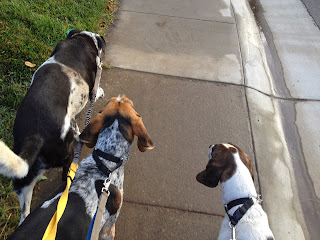
When I thought about the pattern he described in my obliques, I realized that the blame belonged to two little furballs that I run almost every day (they run about 30-40 mpw). I run them using a waist pack. The "fast dog" goes on the left side and pulls me ahead. The slow dog goes on my right and constantly drags me from behind. When I asked Dr. Lau whether that could be the cause he said, OF COURSE! STOP DOING THAT! Or, at least change sides with them every run. I knew that my abs were getting worked when I ran them, but I always joked that I was being more efficient and getting in a core workout too. Doing that a few times a week for 3-4 miles would probably be okay. 30+ mpw over 6 months is probably a bit too much. Add on the hard training and the lack of recovery and you get one big shitfest.

So, I am finally turning the corner with this injury. I have been able to run fast all along (ala Lauren Fleshman) but haven't been able to run more than 5 miles easy. I ran 10 miles easy on Sunday and that was a huge breakthrough. My new coach has had me doing speed work for the past 3 weeks the likes of which I have never seen in my running career. I have been pumping out 200s and 400s like a mad woman and have surprised the crap out of myself with the speed that my little legs have. I have always considered myself a marathon slogger, but I am somehow churning out 200m repeats in 33-36 seconds with 400s in 74-77. Cray! I have to say it has been a ton of fun to switch it up. Since I haven't been able to run long, I have really savored the faster running. It's not particularly hard for me. It's just a different kind of stress.

Needless to say, I am learning a lot about myself through this and about training in general. I am excited about seeing where this speed work, combined with the fitness I built before the injury, takes me over the next several months. I am tentatively targeting the Napa Marathon in March as my next big race. One thing I know for certain is that I won't push it if my body isn't coming around quickly enough for that race. I am in no hurry.

One very important lesson that I have learned from all of this is that I am ultimately responsible for me. I employ coaches, chiropractors and massage therapists to help me, but I have to be willing to listen to what they're saying or trust my own instincts when they either aren't speaking up when they should or are speaking a language that doesn't make sense to me. I ultimately make the choice about what to do next and can't blame anyone else for what happens.        

 If I'm being honest, I am excited to be spectating at CIM this year. I have 5 athletes running the race this year and am just as excited for them (maybe even more) as I would be if I were running it myself. The Genius is also poised to have a breakthrough race and I hope to witness that as well! This is a great year to be a spectator. The challenge is going to be getting around the course to see everyone. I can't wait!


Friday, October 11, 2013

In the blink of an eye

I am walking a tight rope right now. It is a very thin rope that represents the line between being super fit and being injured. If I maintain my balance, I will stay on the rope and continue to train hard. If I lose my balance, I will fall into the abyss that consumes injured runners. To do big things you have to walk the tight rope.

About 2 weeks ago, I ran the best workout of my life. I'm not exaggerating. It was 14 miles total and I had 3 x 3 miles at 6:10-6:20 pace with 3 minute recovery jogs in between. I was lucky enough to have a friend just crazy enough to do this workout with me in the dark at 5:30 a.m. We warmed up for a couple of miles and then took off, headlamps flashing along the bike trail. I settled into a nice pace for the first couple of miles and finished the first repeat in 18:36 (6:12 pace). It felt controlled though not necessarily easy. I jogged around a bit and then took off for the second repeat. My legs were feeling excellent at this point and I was shocked to see 18:15 (6:05 pace) on my watch when I hit 3 miles. Wow. I ran the last 3 miles in 18:17 (6:05 pace), with the last mile clocking in at 6:00.

In my build up to Eugene, I had run this workout about 3 weeks out from the race and nailed it. I remember that workout being the mental game changer for me. I knew I was fit. I ran those in 18:50-18:59 (6:18-6:20 pace). So, here I am, 10 weeks out from my goal marathon and I am running 10-15 seconds per mile faster than that? I actually started to freak out a little. thinking maybe I was peaking way too early in this training cycle. My coach tried to assure me this was not a bad thing and that I still had room to get even fitter. I just couldn't shake this ominous feeling I had.  

That feeling was there for a reason. On my evening run that night, I was stopped after about 3 miles by pain in my lower leg. I thought it was my peroneus longus muscle for a while, but the muscle seemed to be okay. I took the next day completely off and then ran the following day going about 7 miles. My entire right leg was tightening up on me.

I tried rolling and getting massage. While the muscles released after the massage, my leg went right back to a rock-like state after every run.  I knew something was really off. I then tried taking days off from running and just cross trained on my Elliptigo. The pain still came on during the next run around 2.5 miles into it. I started playing around with speed and found that I could run fast without any discomfort, but the tightness would start up once I slowed down.

I contacted Dr. John Ball knowing that, if I wanted a shot at getting back to my training, I needed to act fast. I couldn't take much time off from running or I would not be able to ramp up my training in time to peak for CIM. Losing fitness was less of a concern to me given where I was just 10 days before. I left Monday morning for Arizona for the Maximum Mobility Spa. I spent three days in treatment for 5-7 hours each day and walked out with a tenderized right leg and the bruises to prove it.
After day 1

After day 3
I always learn a ton from these visits and this one was no exception. I learned that the IT band attaches in 2 places and that where I was feeling the pain was the lower attachment point, below and to the right of the knee cap. I learned that the manual treatment on my leg hurt Dr. Ball just as much as it hurt me. He kept saying, "how can someone as small as you create this much damage?" I was tenderized on the EPAT machine for more time than I care to recall. This softened up the tissue so John could get in and manually get at the deep adhesions. I also learned that IT band injuries have few cross training friends. The IT band likes swimming and maybe biking, but not elliptical, pool running or ElliptiGO. So, the hard XT I did on the ElliptiGO all week was really exacerbating the problem. Good to know. I got some challenging rehab exercises along with a swift kick in the ass on my way out Wednesday and headed back to Sactown.

My tight rope is very thin and wobbly right now. I can easily send myself flying by trying to force myself back into my training. I have to be patient, smart and respectful of my body's needs or the tissue will not heal. Dr. Ball told me to run every other day. I run to the point that I feel the pain, and then no longer. The idea is that with 48 hours of rest in between runs, the length of time I can run before hitting the pain threshold will increase to have me running as long as I want relatively soon. Then, I can start back to back days of running.

At this point I've taken a total of 4 days off from running scattered over two weeks. Losing a couple more while I heal is no big deal. I am using the bike as my cross training tool but will resort to swimming if necessary if biking starts to irritate the tissue too. I run today to see if I can get farther than 4 miles before feeling the tightness come on. That's where I left it on Wednesday--being able to run 4 without pain. I started with 1.5 miles on Monday, so I'm already making progress.

I had questioned whether I should spend the time and money to head to AZ for this treatment and now there's no question in my mind that I made the right decision. I had a lot of damage that needed to be dealt with and there is no better place to get healed than Maximum Mobility. I also now have a good diagnosis and some rehab exercises that will help me build my hip strength in all the right places. It is also fun to meet elite runners swooping in for some TLC from the good doc. It's like a parade of Runner's World covers. I felt very lucky to get so much of John Ball's time, even though that meant putting up with his sarcastic sense of humor.

Wish me luck, peeps!

Wednesday, September 18, 2013

I love the 80s

This girl did not like to run.
I grew up in the 80's and have photo documentation of big hair and dramatic make up to vouch for that (right). I still love to dance to 80s music and watch reruns of bad 80s sitcoms. Mostly now, I like to run in the 80s. Last week was my first 80 mile week. This week I'm shooting for 87 miles. And, in my workout tonight the 80s were a recurring theme.

I had a workout of 16 x 400m with 1 minute jog recovery. I met up with some super fast ladies for a long warm up of about 6 miles and then we busted out the 400s on the track. 

splits: 83, 82, 80, 81, 82, 81, 80, 81, 80, 78, 80, 80, 80, 80, 79, 78; average = 80

Yeah, so I went back to the 70s a few times there. It wasn't a bad decade. For this girl, that is pretty darn fast. This is on par with workouts I was running prior to running my fastest marathon times in 2009-2010. It gives me hope that my legs are coming around. I am usually not as strong on the shorter workouts, so this is a pleasant surprise.

I am always strong on my longer workouts, like the one I had on Sunday. Again, I was graced with great company and a great pace pusher. She sat on my tail the whole way to remind me that she would eat me up if I fell back. This was the same workout we had run the day I tried not to poop my pants. Here's a comparison of the two workouts:

August 18th: 17 miles in 2:00  
5 x 1 mile @ 6:10-6:20 w/ 1 mile coast @ 7:00-7:30 
actual splits: 
6:14
7:07
6:06
7:14
6:12
7:24
6:12
7:20
6:12
7:12

September 15th: 20 miles in 2:20 
5 x 1 mile @ 6:00-6:10 ) w/1 mile coast @ 7:00-7:15
actual splits:
5:57
7:06
6:01
7:00
5:55
7:07
5:53
7:10
5:51
7:15   

Pretty amazing difference. Now, I know I was impaired during the August workout, but I actually almost repeated the same pre-race ritual for this last weekend's workout. I had a gig the night before, but this one was in the late afternoon. I still managed to get drunk but this time I passed out at around 9. I think the sleep made all the difference and this time, my bowels cooperated--mostly.

Things are starting to click and I am cautiously optimistic that I might have some good fall racing leading up to my first attempt at a Trials qualifier at CIM. As I have stated before, I just need to get into the same shape I was in before Chicago 2010 to feel like I can run sub-2:43 because I believe I was in shape for that time that day had the weather not been so hot. Then, all I need is perfect weather, a great taper and some fast people to pace off of. Not too much to ask, is it?  

I am doing everything I can at this point to stack the deck in my favor. I'll be cutting out alcohol from here on out (after this last beer tonight-I promise!); trying to get as much sleep as I can; trying to get my butt down to racing weight; taking my workout fueling to the next level; and working on the mental aspect of my training. We're getting serious here folks!

Monday, September 9, 2013

10 miles at GMP

Heading toward the finish. Photo by: Jim Glickman.
I ran a 10-mile race yesterday in 1:03:05.

I could choose to be disappointed about not running faster. I should be able to run faster than that, right? The thing is, I just can't be upset about the race. I placed second overall and won some great prizes. I got to hang out with my cool runner friends before and after the race and experience the great Sacramento running community. I ran 10 miles at about goal marathon pace on tired legs, and there is no better marathon training than GMP on tired legs. I was not at all trashed after the race--in fact, I ran another 6 miles later and did an hour of strength training. I woke up feeling great this morning, too. How can I be disappointed about all of that?

I have a choice in which version of my race story to tell you. I can tell a negative version where I wonder why I am not racing well and why my times are "slow". I can choose to question my training, my fitness, my sanity. That version focuses on the negative of the performance without any context. The one that I chose focuses on the positive that came out of the effort and was put into context. The context is the larger goal--a fast marathon whether that happens in December or some later time.

I mentioned in my last post that I had been going back through my training from 2009 and 2010: the 20-22 weeks of training before the two fastest marathons I've run. While it is interesting to look at those training logs, it does not provide the whole picture of what I did to run those times. To understand what got me to that point, you'd have to go back a lot farther than 22 weeks. You'd have to go back 3-4 years. I had been building my fitness and training for those races for years, not weeks. Everything I did as a runner before those races played a role in getting me across the line fast.

For perspective, I like to think back to a goal I had as a runner in 2005. I wanted to break 3 hours for the marathon. I had run 4 marathons at that point with my fastest being 3:20 in Dec 2005. I trained with the goal pace of 6:52 minutes per mile tattooed on my brain for two more years and 4 marathons before I was able to run that fast. What's more, the first time I broke 3 hours was the first time I didn't have to stop and walk at the end of the marathon! That was more of an accomplishment for me than breaking 3 hours. It then took me another 2 years to get close to 2:50. Neither of these milestones happened incrementally. They happened in big jumps. I ran right around 2:55 for three marathons before I hit 2:50.

My point here is that training builds on previous training. That's why consistency and patience are so important. Sometimes when you think you're plateauing, even though you're putting in a ton of work, something pops and you have a spectacular performance. The key is that you have to keep putting in the work and you have to continue to believe that it will happen.

This has been my secret weapon. I believe I can run a spectacular marathon race even though my training and racing may not indicate that I should be able to run what I do. I may question my ability to run a fast 5k or even a half marathon, but I know, under the right conditions, I can run a great marathon. I prepare myself for it, and I let it happen.

That's not to say that I don't have my share of melt downs before marathons and work myself up unnecessarily. I do! I was pretty worked up before the Eugene Marathon this year because my training was so sketchy. I didn't feel that I had put in the work for the race, and I freaked out about it the week of the race. I especially freaked out the Tuesday before the race when I was out in the field for 18 hours, hiking 10 miles up and down hills all day. I threw my expectations out the window and ran the race by feel. I had done few if any goal marathon pace workouts at the pace I was able to hold in that race.

Experiences like Eugene and the other unexpected performances I've had reinforce in me the belief in the magic of the taper and of race day. You have to be willing to let it happen and trust in your body and mind to get the job done.

I think Journey wrote a song about that, right? Hold on to that feeling. You know you're singing it right now.